Published November 27, 2026
Searching for "packers and movers near me" on Google mostly brings up local map listings—and that is precisely where many fraudulent moving operators hide. A fake moving company does not need a real warehouse or fleet to look legitimate online. All it takes is a Google Business Profile with a trustworthy name, a map pin dropped in your city, a batch of five-star reviews posted in the same week, and an active mobile number.
In India, moving scams follow a well-documented pattern. Fraudulent operators often clone established brand names with minor spelling tweaks, copy logos and websites, and even display a stolen GST number belonging to an unrelated business.
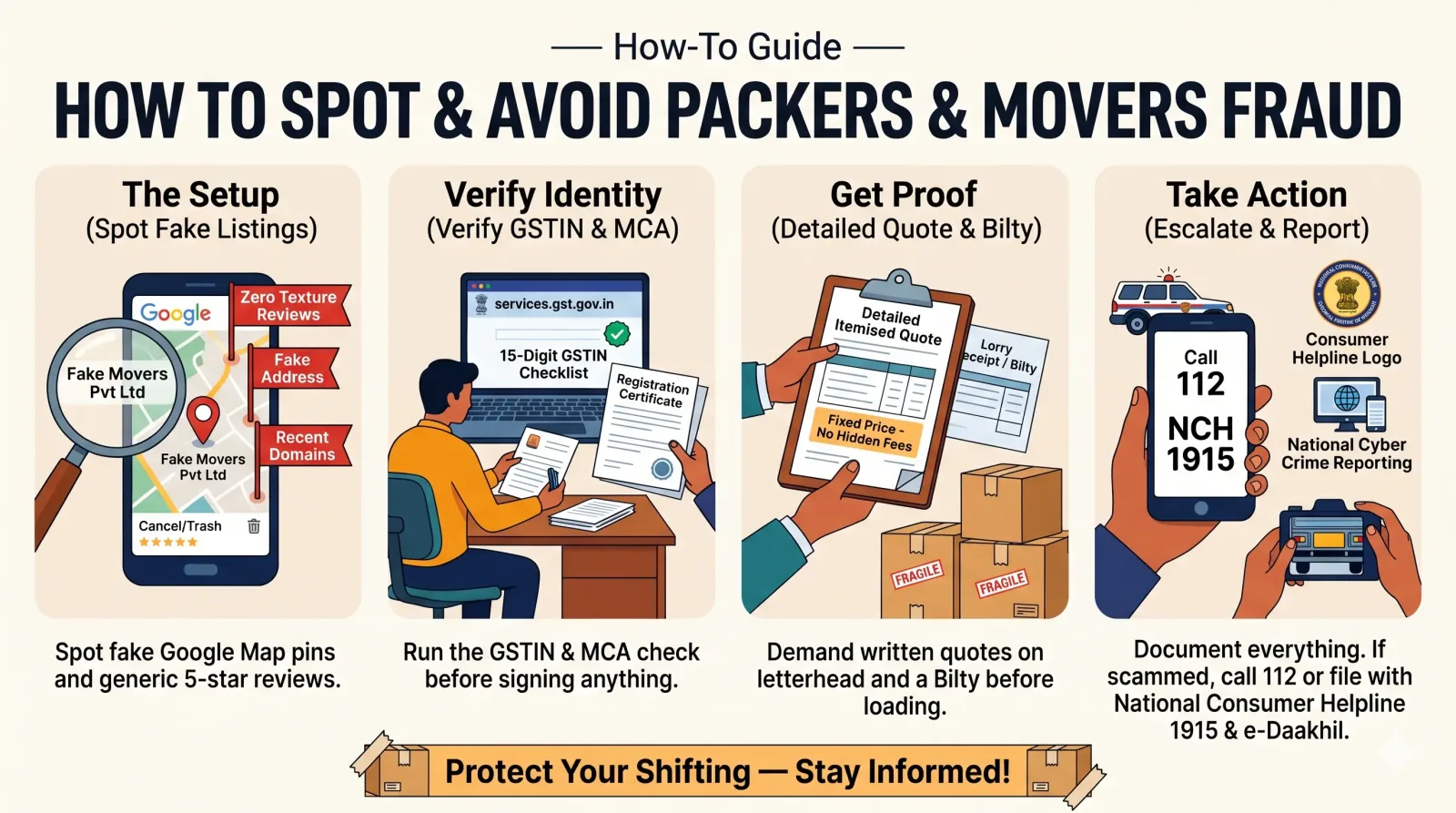
Red Flags of a Fake Packers and Movers Listing
Before booking a house-shifting service, watch out for these warning signs on Google Maps and company websites:
-
Generic, repetitive reviews: Authentic Google reviews mention real details—a supervisor's name, pickup locality, delivery route, or how an issue was resolved. Clusters of vague five-star reviews posted within a few days usually point to a manufactured profile.
-
No verifiable office or warehouse: Search the listed address on Google Maps and inspect it using Street View. A residential flat listed as a "warehouse," an empty plot, or a map pin that shifts between searches is a major red flag.
-
Mobile-only contact details: Relying solely on a personal mobile number and WhatsApp—with no landline or official company domain email—is common among operators planning to vanish after collecting an advance.
-
No review history: Sort the company's Google reviews from oldest to newest. If every review is from the last few weeks, the operator may have abandoned an older profile flooded with fraud complaints.
-
Brand-new website: Check the domain age. A website registered only a few months ago with no verifiable trading history warrants extra scrutiny.
Note: A single red flag does not automatically prove fraud—a genuine small mover may simply have a new profile. However, a combination of no physical office, no landline, newly created reviews, and a recent website is the classic footprint of an advance-fee moving scam.
How to Report a Fake Moving Listing on Google
If you spot a suspicious or cloned moving company on Google Maps, flag it immediately:
-
Open the business profile on Google Maps and select Suggest an edit.
-
Choose Place is closed or not here, then mark it as Offensive, harmful, or misleading.
-
For broader impersonation—such as a stolen brand name, fake phone number, or cloned website—submit a report through Google's Business Redressal Complaint Form (which also lets you upload multiple fraudulent URLs at once).
Important: Reporting a listing to Google only removes the profile from search results; it will not recover lost money or held goods. If you have already been defrauded, follow the legal recovery steps below.
How to Verify Genuine Packers and Movers in India
Unlike the US, India does not have a single national moving licence. Verifying a reliable relocation company requires cross-checking official business registrations and payment terms:
-
Confirm the legal entity name: Ask for the exact registered business name that will appear on your quotation and GST invoice. Trade names often differ from legal names, but a refusal to share the legal entity is a dealbreaker.
-
Verify the GSTIN online: Check the company's GST number on the official GST Portal. Ensure the status is Active and that the legal name and principal place of business match the mover you are hiring.
-
Check MCA or Udyam registration: Verify private limited companies on the Ministry of Corporate Affairs (MCA) portal, or check MSME credentials on the Udyam Registration portal.
-
Inspect the physical address: Look up the office address on Google Street View, or visit the branch in person before paying an advance.
-
Cross-check independent reviews: Search the company name alongside keywords like "complaint", "scam", or "fraud" across Google, Justdial, Trustpilot, and the National Consumer Helpline.
-
Speak to past customers: Ask for two or three references from recent relocations and call them to verify their experience.
-
Demand an itemised written quote: Never rely on a WhatsApp message promising "everything included." Insist on a formal quotation on company letterhead detailing packing materials, crew size, vehicle type (dedicated vs. shared truck), and GST as a separate line item.
-
Verify transit insurance: If you pay for moving insurance, ensure the policy is issued by an IRDAI-registered insurer in your name with a verifiable policy number. A self-printed "insurance certificate" on the mover's letterhead offers zero legal protection.
-
Avoid 100% upfront payments: Paying a small token advance to lock in your moving date is standard; paying the full amount before loading is not. Always transfer funds via UPI or NEFT to the company's current account—never cash to the crew—to maintain a clear digital trail.
-
Document move-day details: Before the truck departs, take clear photos of the vehicle's registration number plate and the driver's driving licence.
What to Do If You Suspect Moving Fraud in India
If things go wrong before or during your relocation, act quickly to protect your belongings and recover your money:
-
Halt the move immediately: If the crew arrives late, acts unprofessionally, or demands sudden price hikes before loading, cancel the job on the spot. Walking away from a small booking advance is far better than having your household goods held hostage.
-
Call 112 for police assistance: If a mover withholds your goods or the truck becomes untraceable, dial 112 and file an FIR at your local police station with your quotation, consignment note (bilty), and chat records.
-
Preserve all evidence: Compile your written quote, GST invoice, UPI/bank receipts, household inventory list, before-and-after photos, WhatsApp chats, call logs, driver ID, and lorry receipt (bilty).
-
File a grievance with the National Consumer Helpline (NCH): Register a pre-litigation complaint via the NCH helpline (1915), WhatsApp/SMS (8800001915), email (nch-ca@gov.in), or the official NCH portal/app (available in 17 languages).
-
Escalate via e-Daakhil: Under the Consumer Protection Act, 2019, packers and movers are legally liable for service deficiency. If NCH mediation fails, file a formal consumer complaint online through the government's e-Daakhil portal (you can represent yourself without hiring an advocate).
-
Report online payment scams: If a fake operator disappears after taking an online advance, lodge a complaint immediately on the National Cyber Crime Reporting Portal (cybercrime.gov.in) or call 1930.
-
Raise a bank chargeback/dispute: Contact your bank or credit card issuer in writing as soon as possible with supporting proof to dispute fraudulent digital transactions.