Published November 24, 2026
Moving home involves enough stress without worrying whether the people carrying your furniture intend to disappear with it. Unfortunately, that is exactly what fraud packers and movers do. This guide explains how moving scams work, the warning signs worth taking seriously, and the checks that separate a legitimate company from a convincing fake.
What Are Fraud Packers and Movers?
"Fraud packers and movers" describes companies or individuals who present themselves as licensed moving services but intend to take your money without delivering the move you paid for. They may operate at any stage — the quote, the loading, the transport, or the delivery — and many are sophisticated enough to have professional-looking websites, branded uniforms and cheerful phone staff.
The tactics repeat because they work:
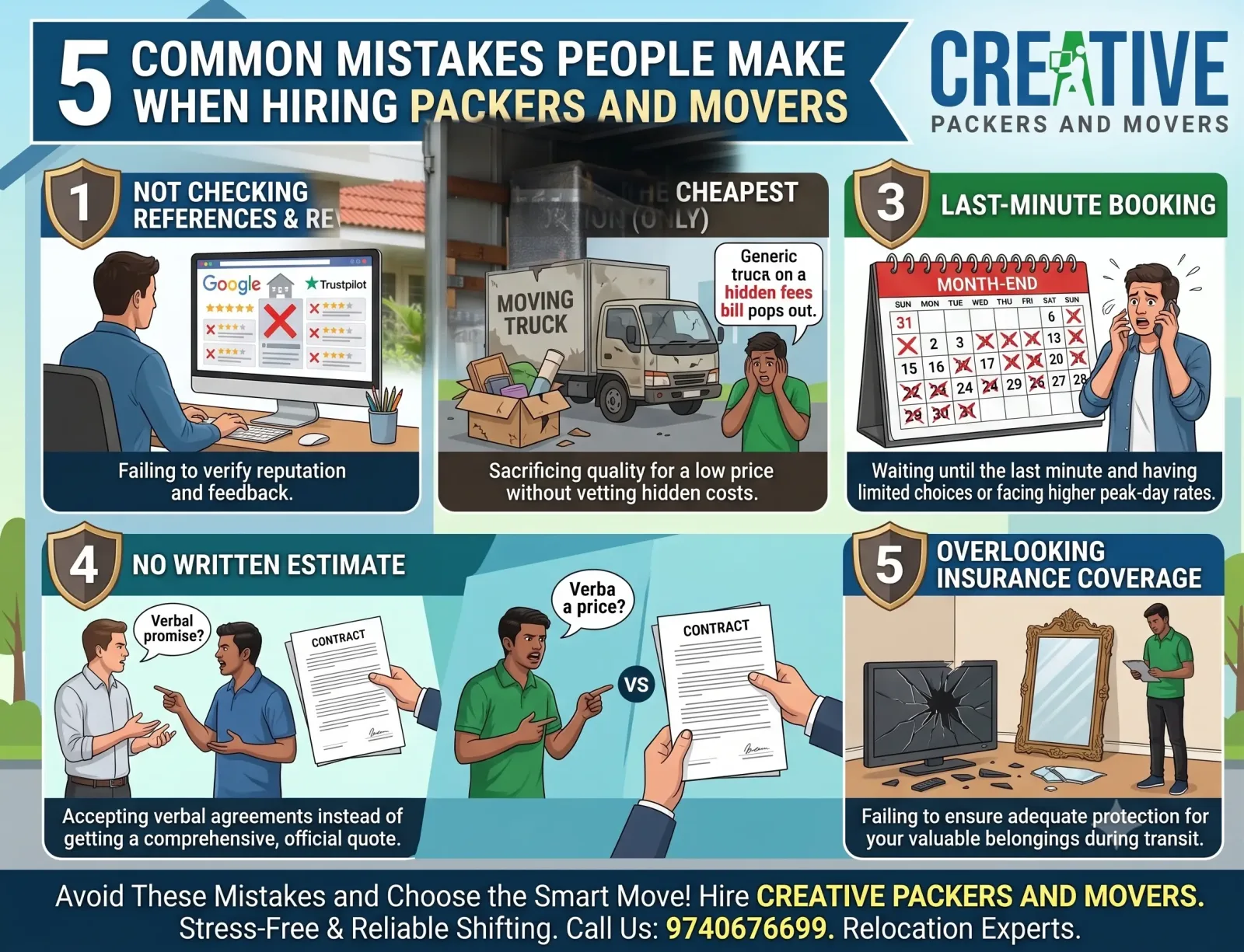
- Bait-and-switch quotes. A rock-bottom estimate wins the job, then the price climbs once your belongings are on the truck.
- Hostage loads. After loading, the mover demands more money than quoted before releasing your goods. Under US federal rules for interstate moves, a non-binding estimate cannot be exceeded by more than 10 percent at delivery, so a demand beyond 110 percent of the estimate is a violation you can report.
- Vanishing trucks. The move proceeds normally until the truck never arrives at the destination.
- Hidden fees. Charges for stairs, long carries, packing materials or "fuel" appear only on the final bill.
- Broker shell games. A company sells your move to an unrelated carrier, then disclaims responsibility when things go wrong.
The scale is real, though hard to pin down precisely because much of it goes unreported. The Better Business Bureau received more than 100,000 inquiries and 718 complaints about movers in 2024, with reported losses averaging $754 per incident. In a 2026 survey of 500 recent movers in the US and Canada, 45 percent reported at least one problem during their move — most commonly undisclosed fees — even though 81 percent said they were confident they could spot a scam. Only about 28 percent had actually verified a mover's licence, insurance or official records.
Concrete example: A homeowner accepts a low phone estimate, the crew loads the truck, and the driver then says the load is heavier than expected and demands several thousand dollars in cash before the truck moves. The homeowner, standing in an empty house with everything they own on the vehicle, pays.
Common Warning Signs of Fraud Packers and Movers
Dishonest operators tend to use the same playbook, and consumer protection agencies have documented it well. According to the US Federal Motor Carrier Safety Administration (FMCSA), these are the red flags to watch for.
| Red flag | Why it matters |
|---|---|
| No on-site or video inspection before the quote | Estimates given sight unseen, by phone or online, are guesses — or bait |
| No written estimate, or "we'll price it after loading" | Removes any agreed figure you can hold them to |
| Cash or a large deposit demanded before the move | Cash is untraceable and unrecoverable; payment apps are nearly as bad |
| Blank documents to sign | You cannot contest terms you never saw |
| No local address on the website; no registration or insurance details | A legitimate business can be visited, and its authority can be checked |
| Claims that "all goods are fully covered" by their insurance | Real coverage has limits, deductibles and valuation options |
| The phone is answered as "Movers" rather than a company name | A sign of a lead-generation front or a rotating operation |
| Pressure to book immediately, or a quote that expires today | High-pressure tactics compress the time you'd use to verify |
| Quotes far below every competitor | Reputable movers cannot undercut their own costs by half |
Some signs deserve their own attention.
Too-Good-to-Be-True Quotes
A quote that lands 40 or 50 percent below three others is not a bargain — it is a business model. The low figure exists to get your goods onto the truck; the real charge arrives later, when refusing to pay is no longer an option. Legitimate movers compete on service, timing and reliability, but their fuel, labour, insurance and equipment costs are broadly similar. If one number is far out of line with the rest, the gap is where the scam lives.
Requests for Cash or Large Deposits
A small deposit to hold a date is normal. A large upfront payment, full payment before the move, or a demand for cash or a payment app transfer is not. Reputable movers expect to be paid in a traceable way, typically by card or cheque, and taking payment by card matters: if the company turns out to be fraudulent or fails to deliver, you have a route to dispute the charge. Cash leaves you with nothing but a receipt you can't enforce.
How to Verify a Packers and Movers Company
Verification takes about half an hour and is the single most effective thing you can do. In the United States, interstate movers and brokers must be registered with the FMCSA and hold a US DOT number. Local, in-state moves are regulated differently — in some states, such as Arizona, movers have no state licensing requirement at all — so the correct authority depends on where you live and whether the move crosses state or national borders. Outside the US, look for the equivalent transport regulator or consumer affairs ministry and confirm what registration your move requires.
A practical checklist:
- Find the registration number and confirm it matches what appears on the company's website, truck and paperwork.
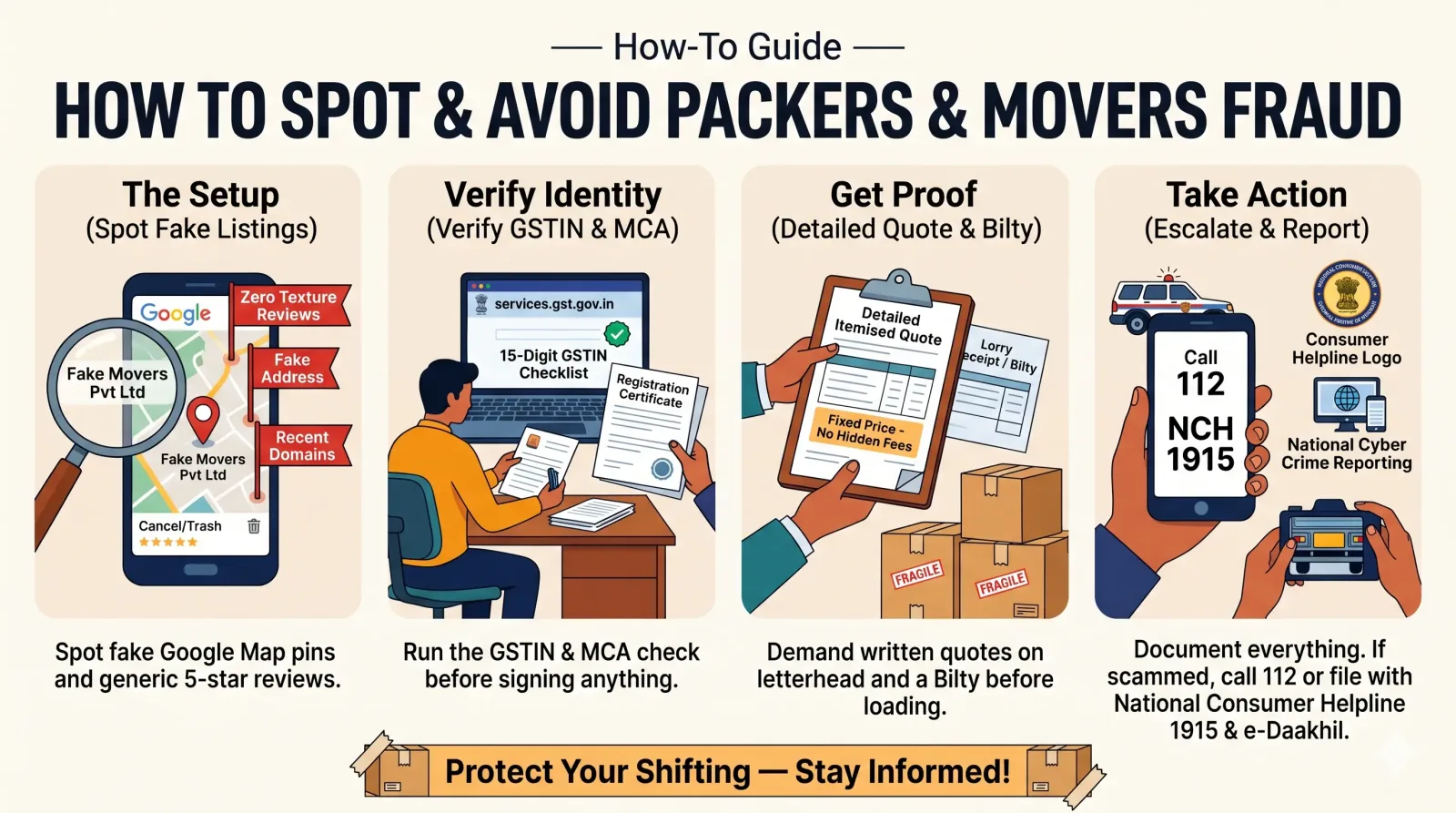
- Look the company up in the official registry. In the US, FMCSA's mover search shows headquarters location, contact details, registration status, business type, complaint history and safety information. A company can be registered yet not authorised to transport household goods — check both.
- Confirm the insurance on file. Interstate movers must maintain the required level of insurance, and the registry shows whether it is current.
- Read the complaint history, not just the star rating.
- Cross-check reviews across several independent platforms and look specifically for patterns around pricing and delivery. Reviews on the company's own site, and on directories it sponsors, prove little.
- Ask for two or three references from recent customers with similar moves, and actually call them.
- Verify the physical address. Search it, and confirm the business appears there.
- Read what you're given. For interstate moves in the US, movers are required to supply FMCSA's Ready to Move brochure and the Your Rights and Responsibilities When You Move booklet before you sign. A company that never mentions them is not complying.
- Never sign a blank document, and keep copies of everything.
Are online reviews enough on their own? No. Fake and purchased reviews are common enough that consumer agencies warn specifically about websites stocked with invented positive feedback. Reviews are one signal among several, and they are weakest when every review is five stars, undated or vaguely worded.
What to Do If You Suspect Moving Fraud
If something has already gone wrong, the order of your actions matters.
- Do not pay any additional demand under pressure, and do not sign new documents at the truck. If goods are being held, tell the driver you are reporting it and do so.
- Document everything. Photograph the truck, the licence plates, the crew, the paperwork and your loaded inventory. Keep every email, text message, call log and receipt.
- Check your rights on pricing. For interstate moves, once you have paid 110 percent of a non-binding estimate or 100 percent of a binding estimate and the mover still will not deliver, they have violated federal household goods regulations.
- File a complaint. In the US, complaints go to FMCSA's complaint centre or the toll-free line, 1-888-DOT-SAFT (1-888-368-7238), which operates 8am–8pm Eastern, Monday to Friday. Have ready: your details, the company's name, address and phone number, the origin and destination, the US DOT and MC numbers if you have them, and a specific account of what happened. Upload your estimate, bill of lading and inventory. Complaints against companies can also go to state consumer protection offices, your state attorney general, and the DOT Inspector General's fraud hotline. Elsewhere, the equivalent national consumer protection body is your first stop.
- Dispute the charge with your card issuer or bank if you paid by card, in writing, promptly and with your documentation attached.
- Report theft or extortion to the police where the conduct amounts to a criminal offence.
FMCSA notes that it cannot resolve individual claims or order a refund, and it does not mediate disputes. Filing still matters: complaints feed the database that drives enforcement, including the agency's nationwide Operation Protect Your Move initiative targeting carriers and brokers with the worst complaint records.
Tips for Hiring Legitimate Packers and Movers
Most moves go smoothly. The way to keep yours in that group is to slow down at the hiring stage.
- Get at least three estimates, in person or by video walkthrough. Reputable movers want to see your home and your goods before quoting.
- Ask for a written estimate and understand which type you have. A binding estimate guarantees you cannot be charged more than the stated amount at delivery, provided the inventory and services don't change. A non-binding estimate is an educated prediction based on estimated weight and services; your final bill is based on actual weight, and you should be prepared to pay up to 10 percent more at delivery.
- Avoid large deposits. A modest holding deposit is fine; anything resembling full payment up front is not.
- Pay by credit card so you retain dispute rights.
- Confirm licensing, insurance and complaint history before signing, using the official registry.
- Read the bill of lading and inventory carefully, and check the inventory against the truck as it loads.
- Understand your valuation options rather than assuming "insurance" covers everything.
A case in point: A homeowner moving interstate gets three in-person estimates, checks each company's DOT number and insurance status through the federal registry, notices one low quote has no registration on file at all, and discards it. The chosen mover performs a full inventory, issues a binding estimate, supplies both required federal brochures, takes a modest card deposit and delivers on the agreed date for the agreed amount. Nothing dramatic happened — which is exactly the point. The defences that work are unglamorous and cheap.
None of this guarantees a flawless move. Fraudsters adapt, and no checklist catches every operator. But verification shifts the odds decisively in your favour, and it costs you an afternoon.
Before you book your next move, use our verification checklist to ensure your packers and movers are legitimate and reliable.
A note on scope: this article is general guidance, not legal advice, and it names no company as fraudulent. Someone facing a dispute over a specific move should speak to a consumer protection agency or a qualified professional in their jurisdiction.
Two things worth deciding before this goes live: the brief asks for internal links to five related pages, and I have no way to resolve those URLs here, so they still need adding. The licensing section is also written with US rules as the worked example, since that is where the sourced detail sits — if your audience is primarily Indian, tell me and I'll rebuild that section around the equivalent Indian framework.